
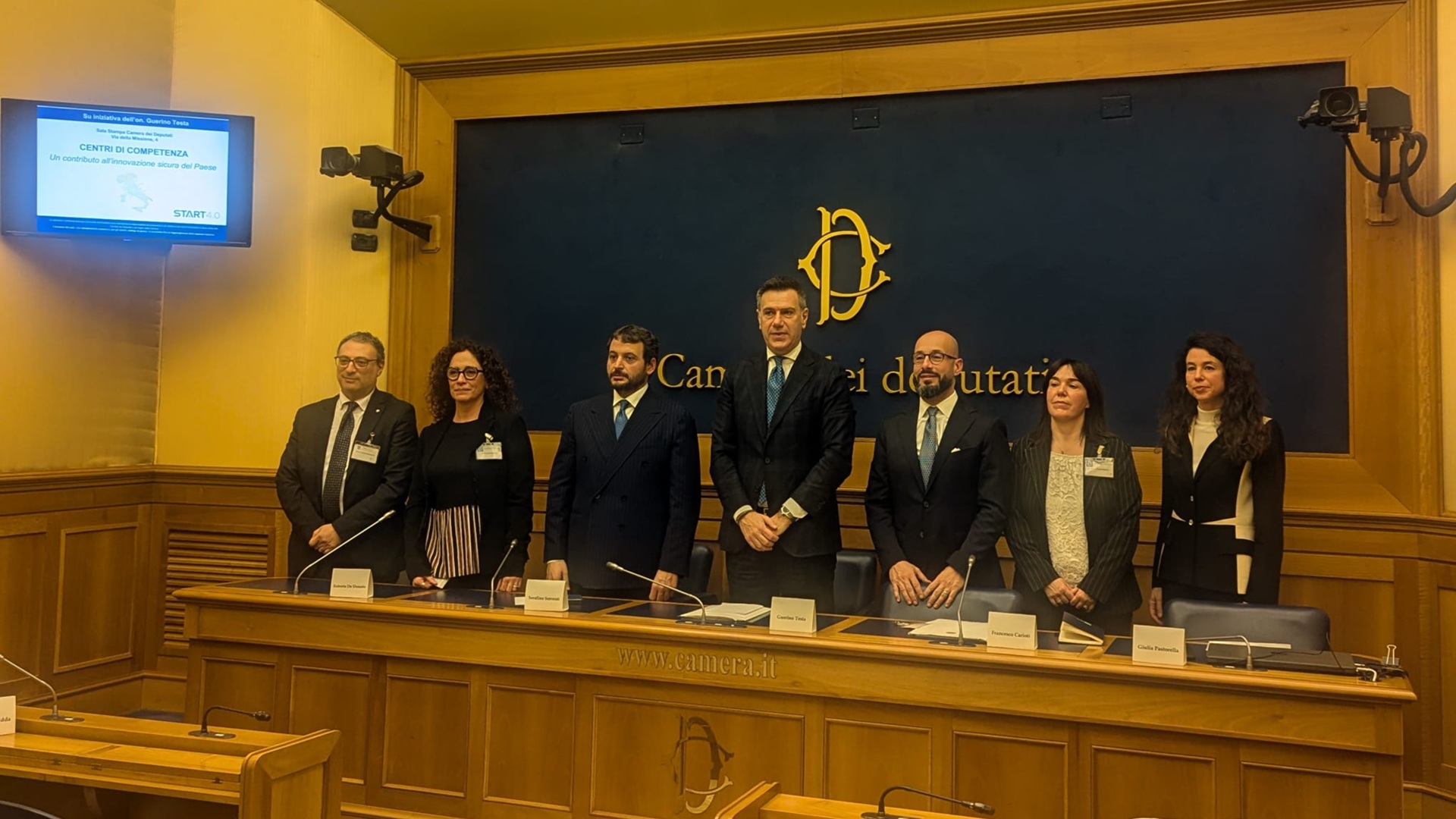
Today, START4.0 spoke at the Chamber of Deputies during an institutional meeting with parliamentarians and stakeholders dedicated to the role of Competence Centers in the digital transformation of the Italian production system.
The event provided an opportunity to discuss the value of an operating model which, on behalf of the Ministry of Enterprise and Made in Italy, has helped to make the investments of the PNRR (National Recovery and Resilience Plan) concrete and effective, supporting businesses and public administrations in the adoption of advanced technologies in a safe, sustainable, and measurable way.
The debate focused on the real impact on businesses. START4.0 illustrated how, through its intervention, numerous SMEs and organizations in different geographical contexts have improved their competitiveness, productivity, and capacity for innovation. The results presented, supported by concrete use cases and measurable data, demonstrated how innovation, if properly managed, can translate into widespread value for the economic system.
Roberta De Donatis, Executive Manager, and Georgia Cesarone, CTO, spoke on behalf of START4.0.
In her speech, Roberta De Donatis picked up on the thread of reasoning developed by the previous speakers, shifting the focus from why Competence Centers exist to how and why these models actually work. She highlighted that this is a key point in the debate on industrial policy and the use of public funds, which is often accompanied by the question of how to ensure that investments produce concrete value and are not wasted on abstract interventions that do not meet the needs of the national production system.
De Donatis emphasized that the role of Competence Centers, and START4.0 in particular, has been to transform a vision of industrial policy into technical, operational, and measurable actions. Being the operational arm of the Ministry of Enterprise and Made in Italy, he explained, is not a slogan but a daily responsibility: to get funds where they are really needed and put them in a position to generate a concrete impact, assuming technical, operational, and strategic responsibility.
In her contribution, Georgia Cesarone focused on the theme of innovation, which she defined not as an abstract concept, but as a tool to be understood, governed, and responsibly integrated into companies’ production, organizational, and decision-making systems. In a phase characterized by the increasingly pervasive entry of artificial intelligence into production processes, services, and critical infrastructures, Cesarone highlighted how the challenge is not only about technological adoption, but above all about the governance of AI, addressing issues such as security, algorithm reliability, responsibility, and data quality.
The CTO of START4.0 referred to the national and European regulatory framework, recalling the role of the decree on artificial intelligence and the constant dialogue with institutions, including the National Cybersecurity Agency. This process, she explained, supports companies through assessment models and support programs, with the aim of helping them understand that regulatory compliance is not merely a formal requirement, but a strategic lever for the country’s competitiveness, operational continuity, and technological sovereignty.
Among the key points that emerged during the meeting, START4.0 placed particular emphasis on the quality and reliability of the technical interventions proposed. The use of structured methodologies based on detailed analyses of digital maturity and risks was highlighted, alongside an experimental approach based on prototypes, assessments, and simulations. This method has enabled companies to reduce investment risk and public decision-makers to measure the impact of policies on the territory in a concrete way.
Another distinctive feature of the model presented was its role as a mediator between research, industry, and institutions, which has made it possible to maintain the high technical and scientific quality of the solutions, while at the same time making them accessible and applicable to the real needs of businesses.
In closing, the speakers emphasized the systemic value of the work carried out: the interventions were not isolated incidents, but contributed to the dissemination of skills and methodologies that can be replicated in other regions and even at the European level. This model, thanks to its ability to translate industrial policies into concrete actions, has demonstrated that a significant portion of the PNRR funds has been used effectively and, according to START4.0, should be strengthened and made structural in order to support the implementation of industrial policies and the governance of innovation over time.
You can watch the press conference “Competence Centers: a contribution to secure innovation in Italy” at this link.