
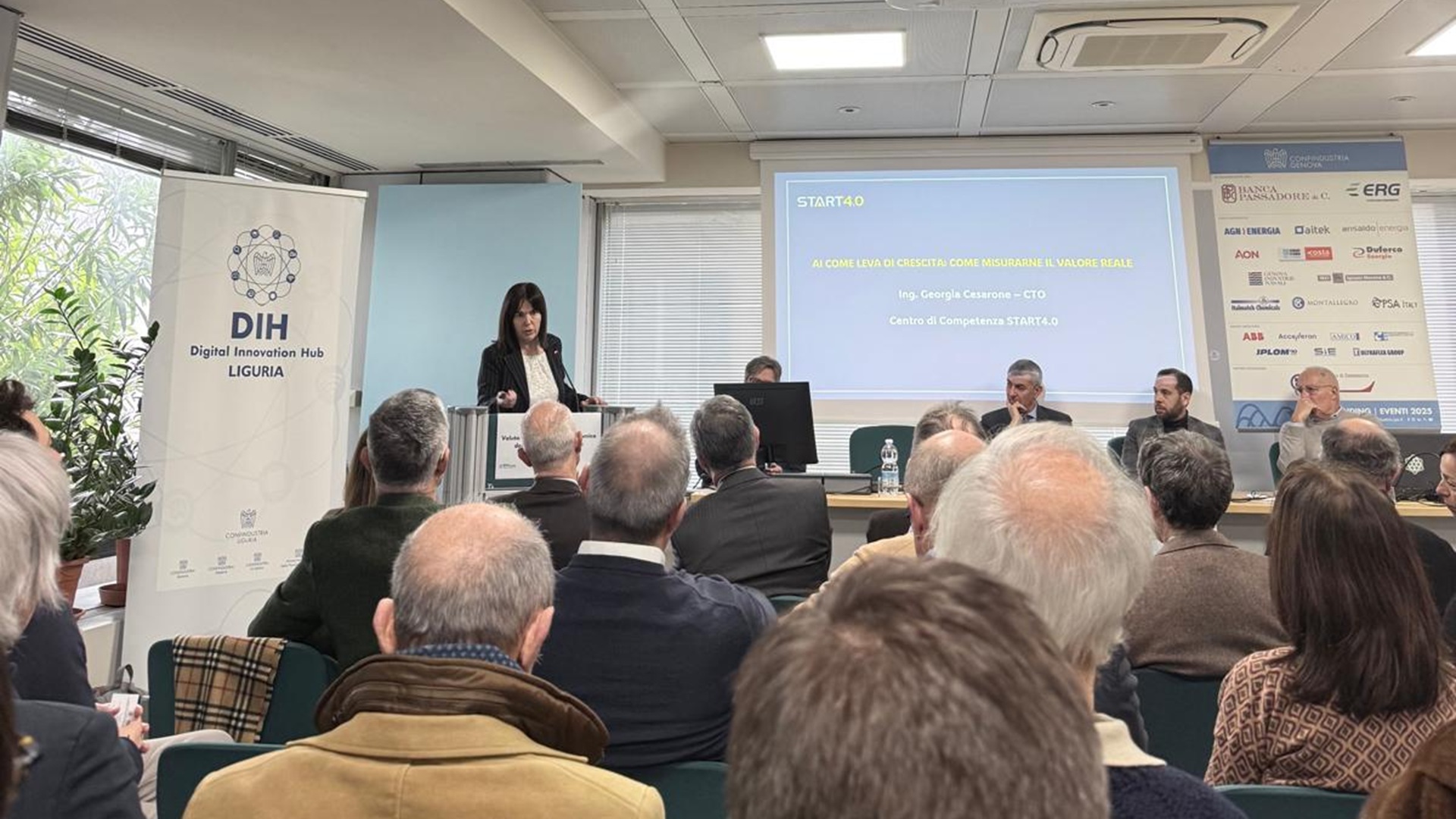
On Friday, January 30, START4.0 participated in the meeting “Assessing the Economic Impact of Artificial Intelligence,” promoted by the Digital Innovation Hub Liguria and hosted by Confindustria Genova. Representing the Competence Center was CTO Georgia Cesarone, who offered a concrete, experience-oriented reflection on how artificial intelligence can generate real value for businesses, particularly SMEs.
The presentation opened with a consideration of the still complex relationship between businesses and artificial intelligence. Compared to other digital technologies introduced in recent decades, AI continues to face strong cultural resistance, which often slows down or hinders adoption processes. Overcoming this barrier is now one of the main challenges in order to fully exploit the opportunities offered by technology.
The focus then shifted to the concept of value, which cannot be interpreted exclusively in terms of immediate economic return. Digital technology—and artificial intelligence in particular—creates value when it reinforces the excellence already present in a company and helps to reduce inefficiencies and critical issues. For this reason, it is necessary to complement the logic of ROI with a broader vision of value on investment, which takes into account strategic aspects such as the quality and speed of decisions, risk reduction, the ability to innovate, and the sustainability of solutions over time.
During the meeting, four areas were identified in which AI can generate value: efficiency, linked to automation and savings in time and costs; effectiveness, which translates into better results and more informed decisions; the possibility of “doing more,” i.e., managing greater complexity and expanding operational capabilities even in smaller organizations; and finally, robustness, understood as greater operational continuity and the ability to adapt to uncertain and changing contexts.
It has been highlighted how artificial intelligence can intervene both by replacing low value-added activities and by supporting people’s work. The most successful cases are those in which technology supports humans, suggesting, synthesizing, and aggregating information, without ever replacing their decision-making role. From this perspective, AI becomes a tool for enhancing skills, not replacing them.
The issue of knowledge scalability is particularly relevant. AI can become a true knowledge assistant, capable of making the experience of highly specialized figures accessible to the entire organization. This approach makes it possible to overcome the limitations associated with the availability of rare skills, improving training, operational support, and process continuity. A concrete example is the combined use of artificial intelligence and virtual reality for technical training in the field, which allows real-time assistance to be provided by drawing on the know-how of the best experts in the company.
Ample space was also devoted to measuring impact, emphasizing the importance of defining clear KPIs before introducing AI solutions, so that their actual contribution in areas such as customer care, operations, cybersecurity, marketing, sales, and training can be evaluated over time.
In presenting START4.0’s activities, the main areas of application in which the Competence Center operates were highlighted: from cybersecurity to sustainability, from digital twins to energy management, to business intelligence and logistics chain optimization. Ongoing initiatives also include the development of on-premise infrastructure dedicated to SMEs, solutions to increase the reliability of AI systems, training courses on dual-use technologies, and the Observatory on AI applied to cybersecurity.
In closing, it emerged strongly that the true value of artificial intelligence lies not only in the technology itself, but in the ability to build trust, skills, and appropriate governance models. In this sense, public-private partnerships and innovation ecosystems are key to guiding companies towards the informed, sustainable, and strategic adoption of AI.